The Problem
Safety in the Internet of Vehicles (IoV) relies on the rapid exchange of hazard information. However, traditional systems often suffer from single points of failure (centralized servers) and high latency. Furthermore, existing blockchain solutions frequently lack "zone awareness," meaning users are flooded with irrelevant alerts from distant locations, or suffer from high transaction costs due to inefficient ledgering.
The Solution: AlertNet
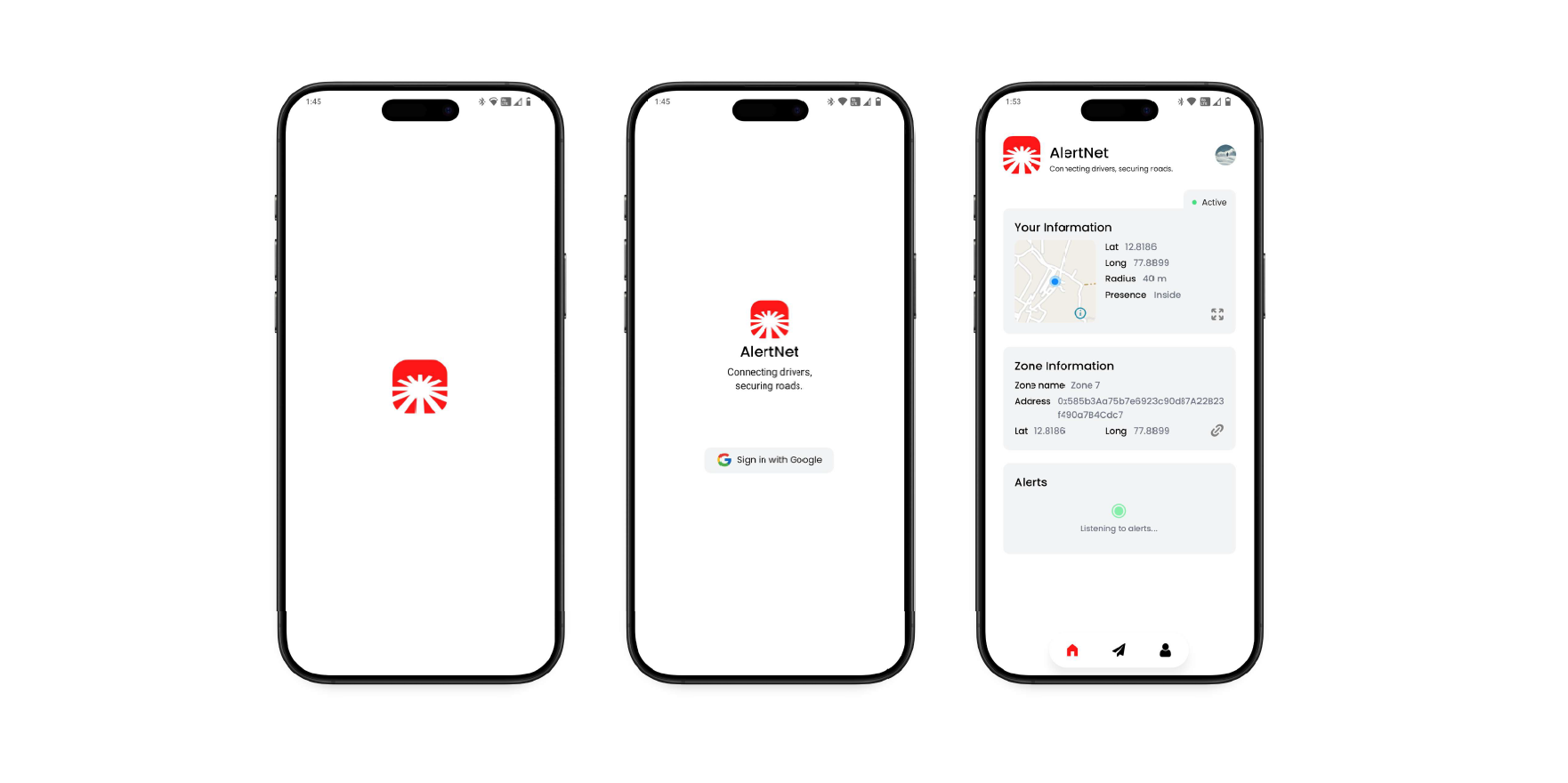
AlertNet is a three-layer decentralized system designed to ensure drivers receive tamper-evident, location-specific alerts in real-time. By coupling cloud geofencing with per-zone smart contracts, we deliver trusted data without the scalability bottlenecks of a single global ledger.
System Architecture
- Perception Layer (Mobile App): A React Native application that locally computes zone inclusion using the Haversine formula. It handles secure Google OAuth 2.0 sign-in and captures live GPS data to display relevant alerts.
- Network Layer (AWS Cloud): A serverless bridge using AWS API Gateway and Lambda functions. The
/findZoneendpoint queries a PostgreSQL (RDS) database to map user coordinates to specific smart contracts, ensuring the app only listens to relevant data. - Application Layer (Blockchain): We deployed separate Smart Contracts for each geofenced zone on the Ethereum Sepolia Testnet. This architecture ensures that an alert for "Zone A" is broadcast only to drivers currently in "Zone A," significantly reducing network noise.
Impact & Results
We deployed a prototype covering seven urban zones and achieved significant performance metrics that validate the system's viability for real-world use:
- Low Latency: The system achieved an average end-to-end confirmation time of 9.4 seconds (from app → cloud → chain → app), suitable for near-real-time safety warnings.
- Cost Efficiency: By using an "event-only" ledgering strategy (emitting events rather than storing massive data on-chain), we minimized gas costs to approximately 0.00000003 ETH per alert.
- Reliability: The system maintained a 96% success rate for alert posting even under intermittent network conditions, proving the resilience of the decentralized architecture.