The Problem
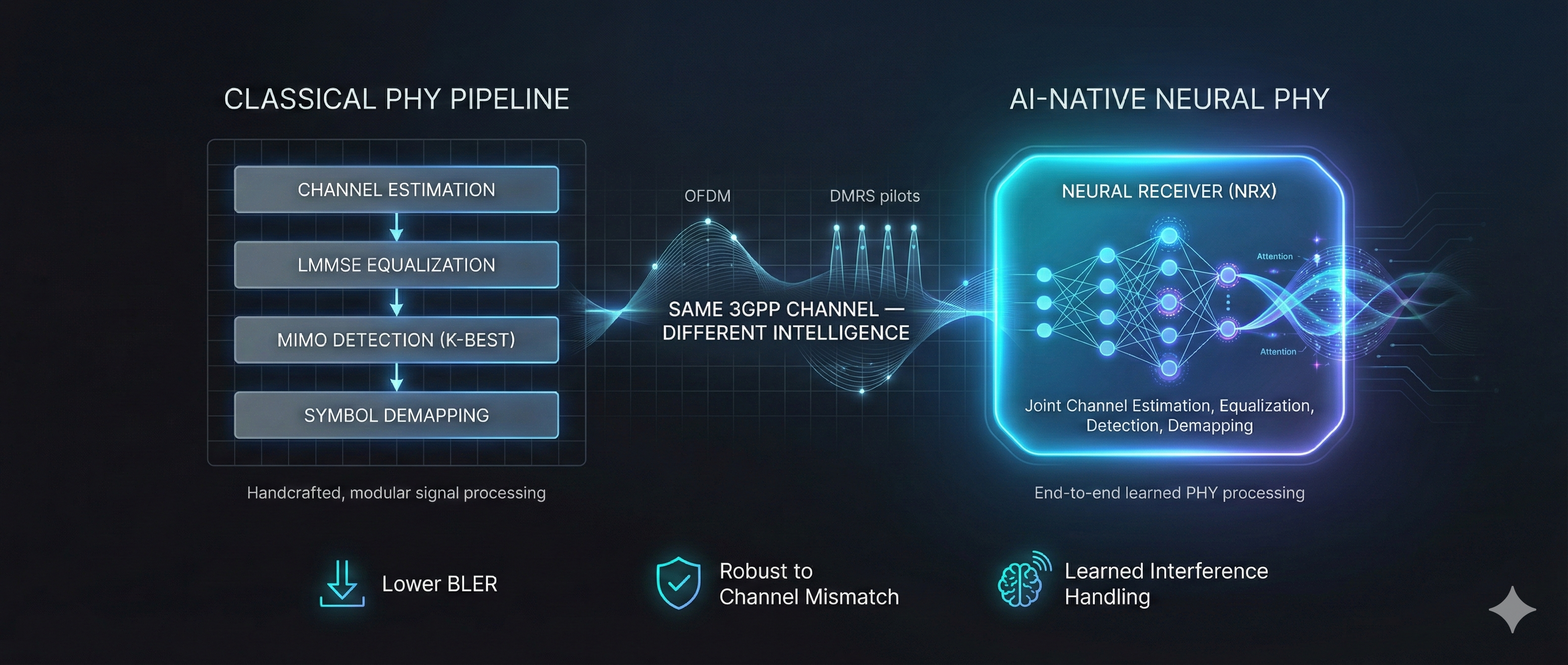
Traditional 5G communication systems rely on rigid, "hand-crafted" blocks for processing signals (Channel Estimation → Equalization → Demapping → Decoding). Each block is optimized independently, which is inefficient for complex channel environments with high interference.
The industry is moving toward AI-Native PHY, where the entire receiver chain is replaced by a single Neural Network (Neural Receiver) that learns to jointly optimize detection and estimation directly from data.
Our Approach
I designed a training-free hybrid receiver that fuses NVIDIA's pretrained CGNN neural receiver with a classical K-Best detector — combining their outputs at the log-likelihood ratio (LLR) level rather than retraining either model. The optimal combining weight (α* = 0.30) was derived analytically from inverse-reliability theory, with a correction term for CGNN's error correlation.
System Architecture
- LLR-Level Fusion: Diagnosed a scale mismatch between CGNN's normalized internal channel representation and the true physical channel — establishing that hybridization had to happen at the LLR level, not the channel-estimate level.
- Simulation Stack: Built the full benchmark on NVIDIA Sionna/TensorFlow, implementing LS, LMMSE, and K-Best baselines alongside an end-to-end autoencoder with learned non-rectangular constellations.
- Validation: Ran Monte Carlo simulations across the DoubleTDL 2-user benchmark and multiple channel types (Rician, Rayleigh, AWGN) to test generalization.
Impact & Results
Benchmarked against classical and neural baselines, the hybrid receiver delivered a training-free improvement with real deployment advantages:
- Outperformed LMMSE+K-Best by 0.20 dB, achieving a 3.41 dB gain at BLER=10⁻² on the DoubleTDL 2-user benchmark — with zero model retraining.
- Statistically validated: The combining weight held at 4.3σ significance across 1,000+ block errors and 7 independent SNR points.
- 45% fewer parameters than the prior state-of-the-art (Wiesmayr et al. Large NRX — 241K vs. 440K), with zero retraining GPU-hours versus its reported 122+ A100-hours.
- Real-time viable: ~1.8 ms inference latency on an A100 GPU, within HARQ timing requirements.
This work was documented in a 6-page IEEE conference paper covering the method, optimal-weight theory, and cross-channel generalization results.